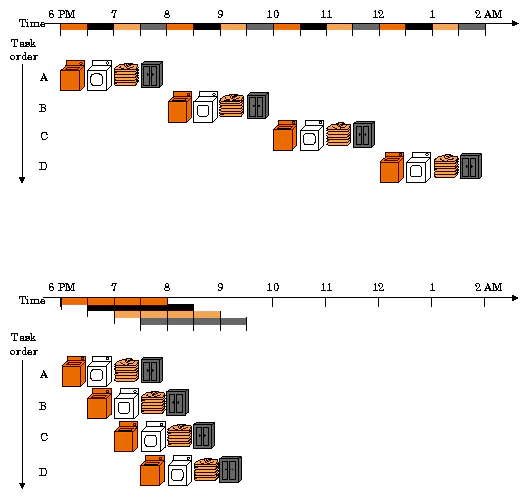
Pipelining laundry day. Top: Naive; Bottom: Pipelined. Credit: Prof. Lois Hawkes, FSU
When doing four loads of laundry, the naive strategy is to wash, dry, fold, and store the first load of laundry before starting on the second one. The pipelined strategy is to start washing load 2 when load 1 goes into the dryer. Pipelining gets work done more efficiently by utilizing multiple resources simultaneously. **Monad** introduces pipelining to address existing bottlenecks in state storage, transaction processing, and distributed consensus. In particular, Monad introduces pipelining and other optimizations in five major areas: * [MonadBFT](/monad-arch/consensus/monad-bft) for performant, tail-fork-resistant BFT consensus * [RaptorCast](/monad-arch/consensus/raptorcast) for efficient block transmission * [Asynchronous Execution](/monad-arch/consensus/asynchronous-execution) for pipelining consensus and execution to raise the time budget for execution * [Parallel Execution](/monad-arch/execution/parallel-execution) and [JIT Compilation](/monad-arch/execution/native-compilation) for efficient transaction execution * [MonadDb](/monad-arch/execution/monaddb) for efficient state access Monad's client, which was written from scratch in C++ and Rust, reflect these architectural improvements and result in a platform for decentralized apps that can truly scale to world adoption. ## Why should I care? Decentralized apps are replacements for centralized services with several significant advantages: * **Open APIs / composability**: decentralized apps can be called atomically by other decentralized apps, allowing developers to build more complex functionality by stacking existing components. * **Transparency**: app logic is expressed purely through code, so anyone can review the logic for side effects. State is transparent and auditable; proof of reserves in DeFi is the default. * **Censorship-resistance and credible neutrality:** anyone can submit transactions or upload applications to a permissionless network. * **Global reach**: anyone with access to the internet can access crucial financial services, including unbanked/underbanked users. However, decentralized apps need cheap, performant infrastructure to reach their intended level of impact. A single app with 1 million daily active users (DAUs) and 10 transactions per user per day would require 10 million transactions per day, or 100 tps. A quick glance at [L2Beat](https://l2beat.com/scaling/activity) - a useful website summarizing the throughput and decentralization of existing EVM-compatible L1s and L2s - shows that no EVM blockchain supports even close to that level of throughput right now. Monad materially improves on the performance of an EVM-compatible blockchain network, pioneering several innovations that will hopefully become standard in Ethereum in the years to come. With Monad, developers, users, and researchers can reuse the wealth of existing applications, libraries, and applied cryptography research that have all been built for the EVM. ## Testnet Monad's public testnet is live. Head to [Network Information](/developer-essentials/network-information) to get started.