> ## Documentation Index
> Fetch the complete documentation index at: https://docs.monad.xyz/llms.txt
> Use this file to discover all available pages before exploring further.
# Speculative Real-Time Data
The Monad architectural overview explains the [asynchronous execution](/monad-arch/consensus/asynchronous-execution)
feature. It is essential to have a basic understanding of how this feature
works before you consume Monad's fastest real-time data feeds, especially
the [speculative execution](/monad-arch/consensus/asynchronous-execution#speculative-execution)
and [block states](/monad-arch/consensus/block-states) sections.
## Why do I need to understand speculative execution?
Monad's design has considerably more parallelism than a typical EVM-compatible
blockchain. This includes nodes speculatively executing the transactions in a
newly-received block before being certain that that block will finalize. The
real-time data feeds are created during speculative execution, so if you
consume them, you might see data about transactions and their effects (e.g.,
logs and balance changes), but *those transactions may never really happen!*
To avoid reacting to blockchain data that is not "real", you need to know how
Monad real-time data feeds express speculative execution, and how they inform
you later whether blocks (and their transactions and state effects) were
ultimately added to the blockchain (or not).
Given this additional complexity, why would you consume these real-time feeds?
The answer is so that *your* software can get the same performance benefits
from speculative execution that Monad itself gets
[(explained below)](#what-benefits-do-i-get-from-speculative-execution).
The cost you pay for this benefit is that you need to understand more about
how Monad works, so that you can write your data processing code correctly.
## Can I consume real-time data without dealing with speculative execution?
Yes.
Monad's JSON-RPC interface supports the `"safe"` and `"finalized"` block tags, which return
data only from blocks that have reached stronger commitment levels (`Voted` and `Finalized`
respectively). See [block states](/monad-arch/consensus/block-states) for details
on what each commitment level guarantees.
Geth-style reorganizations don't occur in the `monadNewHeads` or `monadLogs`
subscriptions. Instead, you are explicitly told what the consensus
algorithm is doing with the blocks you have already seen, so you know what
blockchain data gets committed or not. The purpose of this document is to
explain exactly what this information means, so you know how to react to it.
## What benefits do I get from speculative execution?
Realtime data generated by speculative execution is valuable to a consumer
for two reasons:
1. It allows you to use the same pipelining tricks that Monad itself uses
2. Sometimes it's valuable to react as soon as possible, even when the
data you're seeing is not a sure thing
### Advantage #1: pipelining
Monad's pipelining tricks are explained [here](/monad-arch/concepts/pipelining)
and [here](/introduction/monad-for-users#whats-different-about-monad). You may
recall the below illustration of the laundry analogy, which helps explain the
concept in both places:
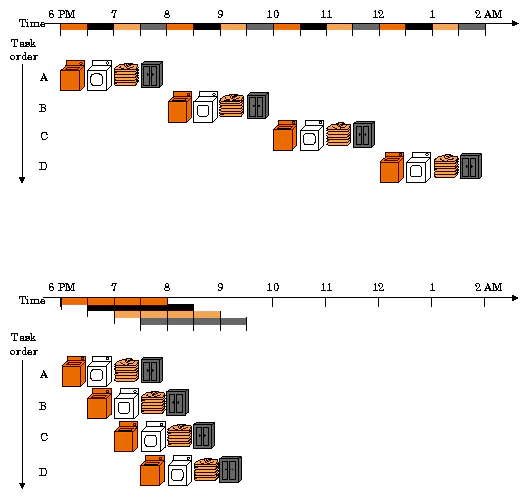
Pipelining laundry day. Top: Naive; Bottom: Pipelined. Credit: Prof. Lois Hawkes, FSU
Here's a concrete example of how you can use pipelining yourself:
Suppose you are writing a automated trading application. Further suppose that
when a certain contract (e.g., a CLOB contract) emits a particular log event,
your trading algorithm uses data from that log event as a signal to buy or
sell.
Before actually trading, you may need to perform additional actions first.
Some of the things you might do are:
* Check your risk limits, to see if increasing the position will
give you too much exposure, or bring you too close to a potential
liquidation
* Run a more complex mathematical model, if your strategy needs to perform
complex computations based on the input in the trading signal
* Create and cryptographically sign the transaction for your buy/sell order
All these things take time, and you can do them *in preparation* for your
eventual trade, while you wait to find out if the block containing the market
signal was actually finalized. If the block *is* finalized, you've already
completed the essential work and can just "pull the trigger" (i.e., send the
presigned trade transaction message). If the block is *not* finalized, you
just throw the preparatory work away and never do the trade.
### Advantage #2: reacting before we know it's "real"
Consider a UI component which wants to keep users informed about the progress
of their transaction. When the transaction is speculatively executed, it can
be marked as `Pending` in the UI, so that the user knows it has been seen and
there's a very good chance it will go through. Even if it fails to progress
to a later commit state, seeing a bit of instant feedback tends to be a
superior user experience.
Also, consider again the example of our automated trading application. Timing
is very important in financial markets. When prices are changing rapidly, a
trade *right now* could be much more valuable than a trade a few seconds
later. It might make sense to initiate a trade *immediately* off of
speculative data, even knowing that some tiny percentage of the time, the
trade is based on a false premise.
You may lose money sometimes, i.e., when your strategy reacts to "not real"
market data in a block that fails to finalize. But *usually* this does not
happen, and the gains from being early most of the time could outweigh the
occasional losses when you react to "false" data.
There are also other kinds of applications, e.g., on-chain games, where
being more interactive is better than being perfectly accurate all the time.
# Block commit states
Elsewhere in the [documentation](/monad-arch/consensus/block-states),
we learned that a block can be in one of four states: `Proposed`, `Voted`,
`Finalized`, and `Verified`. These are sometimes called "commit states" or
"consensus states" in the documentation.
In speculative real-time data feeds, whenever you are given blockchain data, you
will also be told:
* What commit state the associated block is in
* If the initial state was not *verified*, you will be notified at some point
later when the block transitions to a different state
Later in this article, we'll walk through exactly how the process happens in the
current version of the software.
## Block numbers and block ids
Once a block is canonically appended to the blockchain, it becomes uniquely
identified by a (sequentially increasing) block number, also called a "block
height." The inclusion of a block on the blockchain is the goal of the
consensus algorithm, and is called "finalization."
When a block is first constructed, it is constructed assuming it will become
the next block number, `N`. But prior to finalization, consensus nodes are
still trying to agree whether or not this candidate block will actually become
block `N`.
In consensus terminology, a leader constructs a block and *proposes* it to
the Monad network. Consensus nodes vote on the proposal of a particular
candidate block `B` to become the finalized block with number `N`. We call
this candidate block a "proposed block." It's not part of the blockchain
yet, but it probably will be soon.
It's possible for the proposal to fail for many reasons. In the most common
case, the proposed block does not reach enough other nodes before the timeout
period expires, due to network issues.
In that case, you would see another candidate to become the same block number
`N` later on. Because the real-time data feeds are fed by speculative
execution, you might see blockchain data for *both* of the block `N`
candidates, and will be told later which one was correct.
The critical thing to understand is that this blockchain data may claim to be
for "block number `N`", but it's not be the "real" block `N` yet: it's just
a *proposal* to become block `N`.
Consequently, when you see real-time data for a block *before* it finalizes,
the block number alone is not enough to uniquely identify it. This is only
the block number that the block *will* have, if it eventually gets
finalized. Instead, consensus uses a "block id" to uniquely identify
proposed blocks. The id can be used to track a specific block through its
commit state lifecycle.
Consider the following situation:
```
■
║ ┌─────────────┐ ┌─────────────┐
║ │ │ │ │
┌─────────╬──┤ Block 102 ◀───┤ Block 103 │
│ ║ │ id: 79c25 │ │ id: 13a33 │
┌─────────────┐ ┌──────▼──────┐ ║ │ │ │ │
│ │ │ │ ║ └─────────────┘ └─────────────┘
│ Block 100 ◀───┤ Block 101 │ ║
│ id: 5b3a6 │ │ id: 6d585 │ ║
│ │ │ │ ║
└─────────────┘ └──────▲──────┘ ║ ┌─────────────┐
│ ║ │ │
└─────────╬──┤ Block 102 │
║ │ id: 3ed4d │
║ │ │
║ └─────────────┘
║
║
◀ ║ ▶
Finalized blocks ║ Proposed blocks
(committed to ║ (may not become
blockchain) ║ committed to
║ blockchain)
║
■
```
In this diagram:
* Block 101 is the latest block to be finalized
* There are two competing proposed blocks vying to become block 102;
they can be distinguished by their block ids
* One of the proposed blocks (`13a33`) is the parent of another
proposed block
* You might see real-time data for *all* of these blocks; for those
which are not finalized, you can start your pipeline processing right
away, but you *may* want to wait until they reach a better commitment
state before acting
The above situation is very rare in practice, but you should be aware that
it is possible.
# Consensus, execution, and commit states
Monad's real-time data stream is emitted directly by the EVM. In Category
Labs' implementation of a Monad node, execution and consensus are decoupled,
as they are in most Ethereum-compatible blockchain software. That is,
consensus and execution are not *just* different algorithms, but completely
separate programs that communicate with each other. Consensus is the
algorithm (and the daemon) which decides whether or not a potential block
will become part of the blockchain.
Execution hosts the EVM, and executes blocks on a speculative basis, before
it is told the fate of the block by the consensus algorithm. Meanwhile,
consensus is in the "driver's seat": it is the primary driver in the creation
of new blocks, and execution acts as service that consensus uses. However,
only execution produces real-time data and maintains the state database,
because it is the only thing that sees the details of every log, every call
frame, etc.
The exact way that blocks progress from one state to the next is explained below.
Note that a block's state is from the perspective of a particular observer --
for example if you receive a [QC](/monad-arch/consensus/monad-bft#quorum-certificate-qc)
for a block, then you can move that block to the `Voted` state, but if your friend didn't
receive that QC yet, then she would still consider that block to be in the `Proposed` state.
The challenge of building a distributed consensus mechanism lies in defining
rules that allow nodes to individually update their state machines in response
to messages even while assuming the worst, i.e. even while assuming that they
might be the only one that received that message.
## First commit state: `Proposed`
When a new block is proposed by a leader (a Monad validator node), it is sent
from that leader's consensus node to all other consensus nodes to be voted on.
From the perspective of each of those nodes (as well as any observers), if
the block is valid (i.e., follows all protocol rules), it is in the
[`Proposed`](/monad-arch/consensus/block-states#proposed) state.
Upon receiving a valid block, each consensus node will send a "yes" vote
to the next leader, while also scheduling it for immediate [speculative execution](/monad-arch/consensus/asynchronous-execution#speculative-execution)
by its local execution daemon.
Shortly after this happens -- even as the "yes" vote is starting to be
transmitted over the Internet -- the execution daemon begins executing the
proposed block in the EVM. A few milliseconds later, the EVM will begin
publishing real-time data for this block.
In the current implementation of the software, *all* blockchain data is first
observed in the `Proposed` state. A `Proposed` block is a tricky thing. Nearly
100% of proposals that are received do eventually become finalized. In a
statistical sense then, seeing a `Proposed` block seems quite good.
However, that is because usually the global Monad network is functioning
properly: the vast majority of the time, there are no major telecom outages
on the Internet and there is no attempted malicious activity going on.
You are seeing the block so early, that no one has voted for it except you
(if you are a validator), and the leader that proposed it. The first stage vote
is occurring in parallel, at roughly the same time that you are watching
real-time data from its execution.
This is the paradox of a `Proposed` block: the transactions within it are almost
certainly going to happen. And yet if you need very high levels of assurance
before acting, it would be foolish to assume they definitely will: the
blockchain's primary defense against errors, outages, and attacks (its consensus
algorithm) has not weighed in yet.
Make sure you understand the implications of a block being in the `Proposed`
state: it's very early, but has no defense against network problems, software
errors, or malicious behavior. Each later stage reduces the likelihood of
problems occurring, and the kinds of problems that can occur.
## Second commit state: `Voted`
As mentioned above, the consensus algorithm is conducting a first round vote
on whether or not that block will be appended to the blockchain. The goal of
this referendum is to produce a "quorum (minimum number of required votes
for referendum to pass) of "yes" votes.
The vote is coordinated by the second-round leader, who gathers a quorum of
cryptographically-signed "yes" votes into an aggregate signature called a
"quorum certificate" ([QC](/monad-arch/consensus/monad-bft#quorum-certificate-qc)). The second round leader sends out that QC to all
consensus nodes.
If you have received a QC on a block, that means that you
have proof that the block passed the first round of voting. When this
happens, you may consider the block to be in the
[`Voted`](/monad-arch/consensus/block-states#voted) state.
A few things to note about the voted state:
### `Voted` does not mean it's on the blockchain
A block *cannot* yet be definitively appended to the blockchain when it reaches
the `Voted` state. Monad's consensus algorithm uses two rounds of voting.
Possession of a QC (i.e. proof that the first round concluded in most
participants voting yes) removes the most common kinds of risks, but some risk
of being reverted remains.
Possessing a QC removes the risk that a block will be "lost" due to the most
common issues such as network outages and latency issues. Even if it turned
out that you were the only observer with this QC due to a severe network outage,
Monad's consensus algorithm has a fallback mechanism that ensures that the
original block will be reproposed and ultimately finalized under almost all
conditions.
Under what conditions is the existence of a QC not enough? [Several things must
have happened](/monad-arch/consensus/monad-bft#the-only-loophole), but the most notable is that the original leader must have
*equivocated*, i.e. proposed two different blocks at the same block height,
sending each to a different set of nodes.
Equivocation is an unlikely thing for a leader to do, since it is an easily
attributable fault (proof is just the pair of conflicting blocks signed by the
same leader), and since the leader only hurts themselves by invalidating their
own proposal. This is why a block that has reached the `Voted` stage is very
likely to be finalized.
### A block might never enter the `Voted` state
A proposed block might never receive a QC, if its first consensus vote fails.
The most common reason that a block does not get voted in is network latency
issues. Suppose, for example, that both your node and the leader are in
Australia, and there is significant congestion with the cross-continental
network traffic. In that case, most of the blockchain nodes may not learn
about the proposal before the timeout period expires, and the vote will fail.
Note that you will *not* be told that the vote fails. The failure of the vote
is *implicit*, but you can tell it happened because of the next property.
### For some block number `N`, *some* proposed block will eventually be voted in
If you do not receive a QC for a particular block with block number `N`, then
at some other time you will receive a *different* proposed block to become
block `N` and that *will* receive a QC.
A sequence like the following may occur:
* You see all of real-time data for some block `B1`, which is proposed to
become block number `N`
* You see a *different* block, `B2` (and all of its execution events) also
competing to become block `N`
* `B2` receives a QC, and this is the only thing that happens. Namely, `B1`
does *not* receive an explicit "abandonment" event: it is just never
mentioned again, and is implicitly abandoned by the network endorsing
another block with the same number
## Third commit state: `Finalized`
[`Finalized`](/monad-arch/consensus/block-states#finalized) means the block is now part of the canonical blockchain and cannot
be reverted without a hard fork. From this point forward, we no longer need
the block id and can refer to a block solely by its block number.
When a block number `N` is finalized, it *implicitly* abandons all other
proposed blocks with the same block number `N`. Such blocks could be in either
the proposed or the voted state. We say the abandonment is implicit because no
event will be recorded to explicitly announce the abandonment of previously
seen block id.
If you are using pipelining programming techniques when you consume real-time
data, then you are probably keeping track of some state associated with
unfinalized blocks. In our trading example, this would be the pre-prepared
buy or sell order transaction message.
Every time a block is finalized, you read must check for any blocks
(1) with the same block number, but (2) with a different id, and abort your
pipelined processing for those blocks. They will never be appended to the
blockchain and the associated transactions and their effects -- whose
execution events you have already seen -- will never occur.
### Why are there two different stages of voting?
This is because the *subject* of the vote -- the thing we are trying to
get agreement on -- is different.
1. In the *first* vote, the network wants to verify that a block satisfies
all the protocol rules. If a QC is obtained, we know that a majority
of the honest nodes agree that the block *should* be added. This first
vote is called the "voted" stage since *the block itself* has been
voted for.
2. In the *second* vote, we want to get cryptographically secure agreement
that *enough of the network has actually seen the result of the first vote*.
This second vote is called the "finalized" stage since, now that everyone
knows the first vote succeeded, they can also agree that it must be the
next block on the blockchain.
The second vote is trying to answer the question posed by the old saying
"If a tree falls in a forest and no one is around to hear it, does it make a
sound?"
Consider how the "fan-in, fan-out"
[linear communication pattern](/monad-arch/consensus/monad-bft#happy-path)
of the BFT protocol works. We talk about nodes "having a QC", but the QC is
computed by the leader of the next round -- this leader is the one actually
"conducting" the vote.
Even if the leader is dishonest, it cannot forge the vote because it cannot
forge other nodes' cryptographic signatures. But it *can* fail to successfully
tell enough of its peers about the QC, since it must communicate the QC to
everyone. Network problems are common, so communication can always fail.
Thus we need a second round of voting, for validators to reach distributed
agreement about the fact that they've seen the first QC. Now it's safe to
assume that everyone (or at least the honest majority) will have the same
canonical blockchain.
The reason that `Voted` is a very reliable commit state on Monad is that if
common problems occur during the *second* stage vote, the
algorithm will continue trying to conduct the second stage vote, failing only
in some narrow corner cases involving equivocation.
## Fourth commit state: `Verified`
The consensus algorithm produces one last state transition for a block, called
[`Verified`](/monad-arch/consensus/block-states#verified).
The `Verified` state is a consequence of Monad's [asynchronous execution](/monad-arch/consensus/asynchronous-execution). Recall
that a consensus node votes on a block *before* its execution is complete.
This implies that consensus must be voting on the block's execution inputs,
but *not* on the block's execution outputs.
Consensus nodes cannot be voting, for example, on the correct value of the
state root produced by the execution of the block, because they don't know
what it is (remember, it is being computed in parallel with the vote
occurring). This means that the `Voted` state does not certify the
correctness of any output fields in the Ethereum block header such as
`state_root`, `receipts_root`, etc.
This is possible because any well-formed Ethereum block will have completely
deterministic effects on the blockchain state, when executed by a conforming
EVM implementation. Thus, it is safe to append a block onto the blockchain,
knowing that everyone will agree on its behavior, even if we don't know
exactly what the behavior will be.
Clearly though, for the blockchain to be reliable, consensus nodes *must*
eventually vote on the correctness of the execution outputs. Suppose they did
not, and further suppose that a bug existed in some execution nodes but not
in others (perhaps running a different version of the client software). If
there were no mechanism to feed the execution outputs back into consensus
decisions, the state could become forked without anyone noticing. Consensus
proposals *start* by assuming that all execution nodes will compute the
correct state, but to prevent bugs and malicious actions from compromising
the network, it must check that this happens eventually.
Here is how Monad solves this issue:
To give execution ample time to finish, execution outputs for block `B`
are not incorporated into the consensus protocol until three rounds in the
future, alongside the proposal of block `B+3`. When *this* proposal is
finalized (ideally two rounds later, during the proposal of block `B+5`),
then a supermajority of nodes will have voted for the correct values of
the execution outputs.
To roughly summarize the difference:
* `Finalized` means the block's definition (i.e., its transactions) are
definitely part of the blockchain
* `Verified` means that a supermajority stake's worth of other nodes have
verified that your local node's computation of the state changes of these
transactions match the supermajority's
To understand more, read [here](/monad-arch/consensus/asynchronous-execution#delayed-merkle-root).
Does this imply that verified state is the gold standard for "100%, can never
fail" transaction reporting? Also no, if you are trusting a data feed produced
by a single node. Who is to say, for example, that the node producing the data
in not suffering from a bug, or has been hacked?
As always in the blockchain universe, critical transactions that demand
*total* peace of mind can only be verified by widespread agreement, *broadly*
defined. This includes explicitly checking with other nodes, to ensure no
hosts or network intermediaries have been compromised and the software is
working properly.
In practice, the `Voted` state is usually good enough for most things: it should
*very* rarely revert in practice, so it is also used as the `"safe"` block tag
in Monad's RPC implementation.