> ## Documentation Index
> Fetch the complete documentation index at: https://docs.monad.xyz/llms.txt
> Use this file to discover all available pages before exploring further.
# Staking Overview
> How to interact with Monad's staking system
export const CopyToClipboard = ({value, children}) => {
const [copied, setCopied] = useState(false);
const handleCopy = async () => {
try {
await navigator.clipboard.writeText(value);
setCopied(true);
setTimeout(() => setCopied(false), 1000);
} catch {
const textarea = document.createElement("textarea");
textarea.value = value;
textarea.style.position = "fixed";
textarea.style.opacity = "0";
document.body.appendChild(textarea);
textarea.select();
document.execCommand("copy");
document.body.removeChild(textarea);
setCopied(true);
setTimeout(() => setCopied(false), 1000);
}
};
return
{children}
;
};
Monad uses a [precompile](/developer-essentials/precompiles) to manage validator delegation and rewards.
This page covers the key concepts and workflows for interacting with the staking precompile. For the full interface reference, visit the [API](/reference/staking/api) page. To learn how Monad's staking system works, visit the [learn](/monad-arch/consensus/staking) tab.
The staking precompile is at address `0x1000`.
## Key concepts
### Epochs and timing
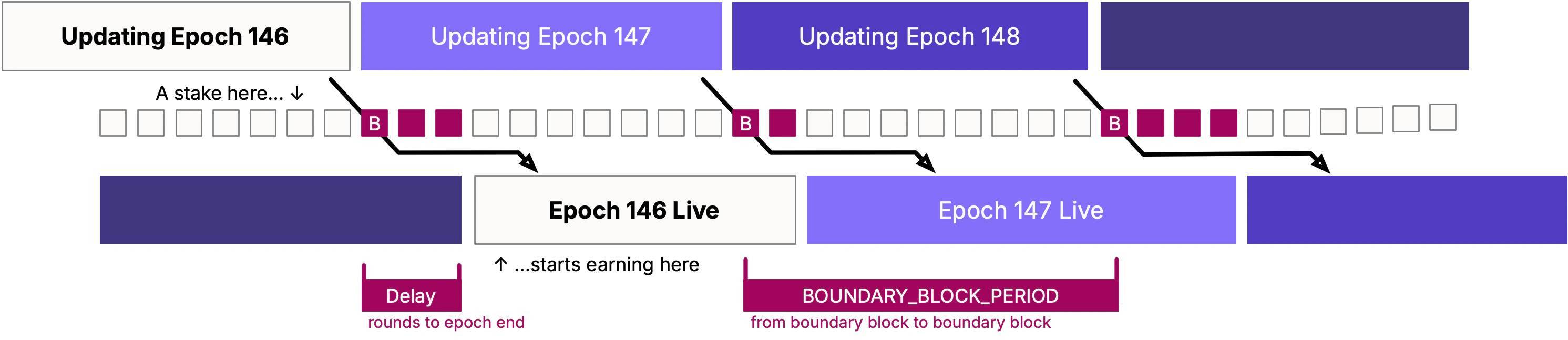
Staking state changes don't take effect immediately. Monad divides time into **epochs**, and most actions only activate at the start of a new epoch.
Every 50,000 blocks (\~5.5 hours) is a **boundary block** that commits upcoming staking changes. After a 5,000-round delay (`EPOCH_DELAY_ROUNDS`), the new epoch starts.
This means your action activates in either:
* **Epoch n+1** — if submitted before the boundary block
* **Epoch n+2** — if submitted after the boundary block (in the epoch delay period)
Use [`getEpoch()`](/reference/staking/api#getepoch) to check the current epoch and whether the boundary has passed:
```solidity theme={null}
(uint64 epoch, bool inEpochDelayPeriod) = IMonadStaking(STAKING_ADDRESS).getEpoch();
// If inEpochDelayPeriod is false: changes take effect in epoch + 1
// If inEpochDelayPeriod is true: changes take effect in epoch + 2
```
A round is not a block — rounds increment even on missed proposals. You cannot calculate epoch boundaries with modular arithmetic on block numbers. Always use `getEpoch()`.
### Withdrawal delay
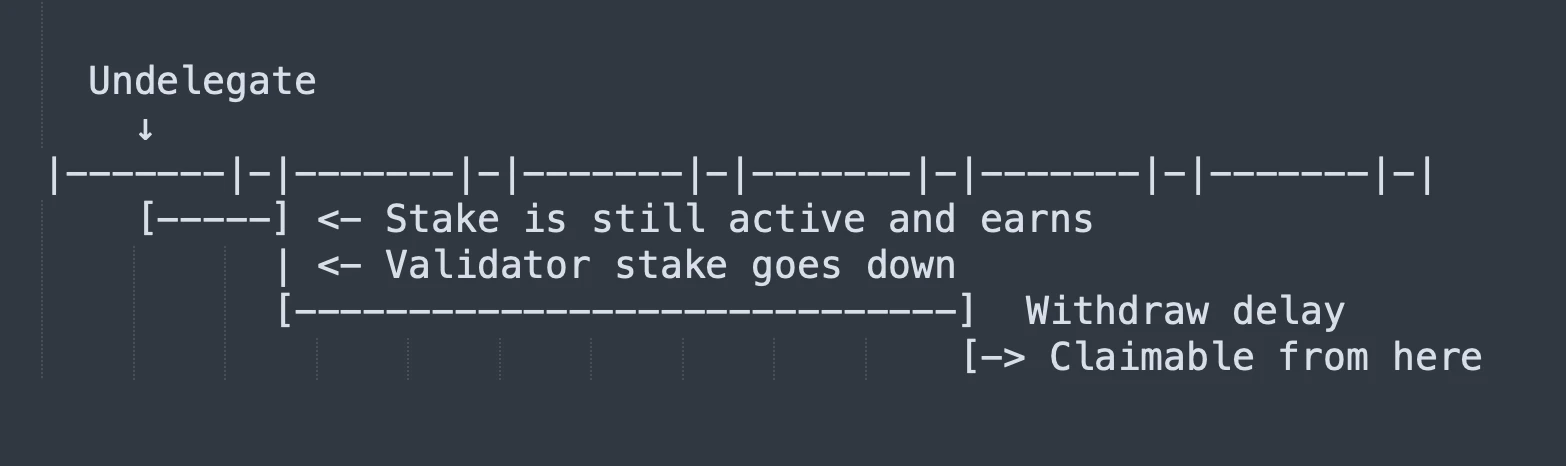
Undelegated stake is not immediately available. After calling `undelegate`, you must wait `WITHDRAWAL_DELAY` (1 epoch) before calling `withdraw` to reclaim the funds.
## Common actions
### Delegate
To delegate MON to a validator, call `delegate(validatorId)` with the amount as `msg.value`:
```solidity theme={null}
IMonadStaking(STAKING_ADDRESS).delegate{value: amount}(validatorId);
```
* `msg.value` must be at least `DUST_THRESHOLD` (1 gwei).
* Your delegation becomes active in the next epoch (or the one after, if past the boundary block).
* If this causes the validator's total stake to meet `ACTIVE_VALIDATOR_STAKE`, the validator is added to the active set.
### Undelegate and withdraw
Removing stake is a two-step process:
**Step 1: Undelegate** — Initiate the withdrawal by specifying the amount and a `withdrawId` (0–255):
```solidity theme={null}
IMonadStaking(STAKING_ADDRESS).undelegate(validatorId, amount, withdrawId);
```
**Step 2: Withdraw** — After `WITHDRAWAL_DELAY` epochs have passed, call `withdraw` to reclaim the funds:
```solidity theme={null}
IMonadStaking(STAKING_ADDRESS).withdraw(validatorId, withdrawId);
```
Timeline of withdrawability of stake relative to undelegate
* You can only undelegate **active** stake (not pending delegations).
* Each `(validator, delegator)` pair supports up to 256 concurrent withdrawal requests.
* `withdrawId`s can be reused after the withdrawal completes.
### Claim and compound rewards
Rewards accumulate automatically as your validator produces blocks. You have two options:
* **Claim rewards** — withdraw accumulated rewards to your account:
```solidity theme={null}
IMonadStaking(STAKING_ADDRESS).claimRewards(validatorId);
```
Claims take effect **immediately** — no epoch delay.
* **Compound rewards** — re-delegate accumulated rewards, increasing your stake:
```solidity theme={null}
IMonadStaking(STAKING_ADDRESS).compound(validatorId);
```
Compounded rewards activate in the next epoch (following the standard timing rules).
### Query staking state
Key view methods for reading staking state:
| Method | Purpose |
| ------------------------------------------------------------------------------------------------------- | ------------------------------------------------------------------------ |
| [`getValidator(validatorId)`](/reference/staking/api#getvalidator) | Full validator state across execution, consensus, and snapshot views |
| [`getDelegator(validatorId, address)`](/reference/staking/api#getdelegator) | Delegator's stake, rewards, and pending changes for a specific validator |
| [`getWithdrawalRequest(validatorId, address, withdrawId)`](/reference/staking/api#getwithdrawalrequest) | Status of a pending withdrawal |
| [`getEpoch()`](/reference/staking/api#getepoch) | Current epoch and whether boundary has passed |
| [`getConsensusValidatorSet(startIndex)`](/reference/staking/api#getvalidatorset) | Current epoch's leader validators (paginated) |
| [`getSnapshotValidatorSet(startIndex)`](/reference/staking/api#getvalidatorset) | Next epoch's leader validators (paginated) |
| [`getExecutionValidatorSet(startIndex)`](/reference/staking/api#getvalidatorset) | All validators meeting active staking criteria (paginated) |
| [`getProposerValId()`](/reference/staking/api#getproposervalid) | Validator ID of the current block's proposer |
| [`getDelegations(address, startValId)`](/reference/staking/api#getdelegations) | All validators a delegator has delegated to (paginated) |
| [`getDelegators(validatorId, startDelegator)`](/reference/staking/api#getdelegators) | All delegators for a validator (paginated) |
Paginated methods return up to 100 results per call. Pass `startIndex = 0` for the first call, then use `nextIndex` for subsequent calls until `isDone` is true.
## Constraints
Because the staking system is a precompile rather than a smart contract, it has some behavioral differences.
* **Only `CALL` is allowed.** `STATICCALL`, `DELEGATECALL`, and `CALLCODE` will revert. This means all view methods use `nonpayable` state mutability rather than `view`.
* **No forked environment testing.** The staking system is a precompile, not a smart contract — there is no code at the address, so forked testing environments won't work.
* **Boundary block timing.** Actions submitted during the epoch delay period (after the boundary block) won't take effect until two epochs later. Check `getEpoch()` if timing matters.
* **Dust threshold.** Delegations below `DUST_THRESHOLD` (1 gwei) will revert.
* **EIP-7702 caveat.** If an account delegates to the staking precompile address using EIP-7702, all calls to it will revert.
## Further reading
* [API reference](/reference/staking/api) — Full reference for the staking precompile with method signatures, parameters, gas costs, events, structs, and ABI
* [How staking works](/monad-arch/consensus/staking) — How Monad's staking system determines validator voting weights, epoch scheduling, and reward distribution
 This means your action activates in either:
* **Epoch n+1** — if submitted before the boundary block
* **Epoch n+2** — if submitted after the boundary block (in the epoch delay period)
Use [`getEpoch()`](/reference/staking/api#getepoch) to check the current epoch and whether the boundary has passed:
```solidity theme={null}
(uint64 epoch, bool inEpochDelayPeriod) = IMonadStaking(STAKING_ADDRESS).getEpoch();
// If inEpochDelayPeriod is false: changes take effect in epoch + 1
// If inEpochDelayPeriod is true: changes take effect in epoch + 2
```
This means your action activates in either:
* **Epoch n+1** — if submitted before the boundary block
* **Epoch n+2** — if submitted after the boundary block (in the epoch delay period)
Use [`getEpoch()`](/reference/staking/api#getepoch) to check the current epoch and whether the boundary has passed:
```solidity theme={null}
(uint64 epoch, bool inEpochDelayPeriod) = IMonadStaking(STAKING_ADDRESS).getEpoch();
// If inEpochDelayPeriod is false: changes take effect in epoch + 1
// If inEpochDelayPeriod is true: changes take effect in epoch + 2
```