

Validator set
To be part of the active validator set, a validator must meet all of the following criteria:- Self-delegation: the validator’s
authAddressmust have self-delegated at leastMIN_AUTH_ADDRESS_STAKE(100,000 MON) - Total stake: the validator must have total delegation of at least
ACTIVE_VALIDATOR_STAKE(10,000,000 MON) - Rank: the validator must be in the top
ACTIVE_VALSET_SIZE(200) validators by stake weight
Rewards and commission
When a block is produced, the leader who produced it earns a block reward from two sources:- Inflationary reward — a fixed
REWARDof 18 MON per block, minted by the protocol - Priority fees — the priority fees from all transactions in the block
Commission
Each validator sets a commission rate (0%–100%) that determines what fraction of the inflationary block reward they keep before distributing the remainder to delegators. The remainder is distributed pro rata by stake weight. As a delegator, your share of a block’s reward is proportional to your stake relative to the validator’s total stake. Example: Suppose you have delegated to a validator and comprise 20% of that validator’s total stake. The inflationary block reward is 10 MON and the commission is 10%. You receive:10 MON × 90% × 20% = 1.8 MON
Priority fees
Currently, priority fees go only to the validator. Validators may choose to share priority fees with delegators (including themselves) by calling theexternalReward method on the staking precompile. Commission is not deducted from external rewards.
Claiming and compounding
Each delegation accumulates rewards over time. Delegators can either:- Claim rewards — withdrawn to the delegator’s account immediately
- Compound rewards — added to the delegation, increasing stake weight (follows the standard epoch timing rules described below)
Epochs and boundaries
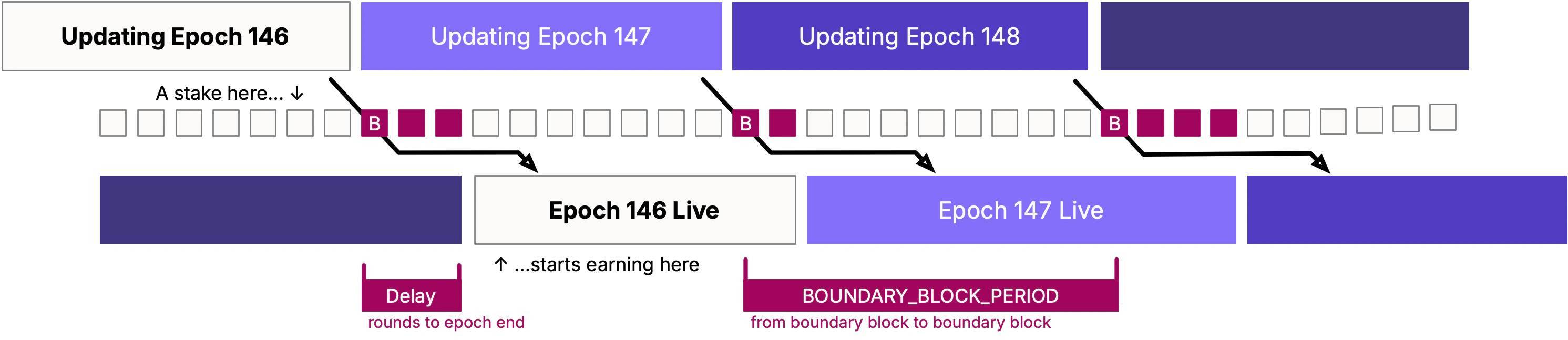
An epoch uses one set of delegations and leader validators for its entire duration. Every 50,000 blocks (theBOUNDARY_BLOCK_PERIOD) is a boundary block that commits the upcoming staking changes and the validator set to be used in the next epoch. Boundary blocks happen approximately every 4 hours 12 minutes. The next epoch does not start immediately at the boundary block, but after a 5,000-round delay (EPOCH_DELAY_ROUNDS) to allow all nodes to update their epoch information.
Timing of staking actions
Most staking actions take effect after they are committed in a boundary block and the next epoch starts. The exceptions areclaimRewards() and externalReward(), which take effect immediately.
As an example, consider delegate() during epoch #4:
- If the
delegate()takes place before the boundary block for epoch #5, the stake will be included in epoch #5. - If the
delegate()transaction is in the boundary block itself, it will not be included in epoch #5 (the snapshot is taken at the start of the block, before user transactions). The delegation will be picked up in the boundary block for epoch #6. - If the
delegate()transaction is after the boundary block but before the end of epoch #4, the delegation will take effect in epoch #6.
The
BOUNDARY_BLOCK_PERIOD is denominated in blocks, while EPOCH_DELAY_ROUNDS is denominated in rounds. If perfect consensus is achieved, these increment at the same rate. However, upon a failed block proposal (e.g. timeout), the round increments while the block does not.Execution, snapshot, and consensus views
The staking system maintains three views that staking state passes through:- Execution view — the real-time state. When validators are added, delegations change, or any staking transaction happens, the execution view is updated immediately.
- Snapshot view — at the start of each boundary block, the current execution view is copied into the snapshot view. Any transaction changes after this point will not affect the following epoch. The snapshot now matches what the next epoch will look like.
-
Consensus view — after
EPOCH_DELAY_ROUNDS(5,000 rounds) from the boundary block, the new epoch starts and the snapshot view is copied into the consensus view. The consensus view holds the validators and voting stake weights being used by the consensus system for the remainder of the epoch.