

Key concepts
Epochs and timing
Staking state changes don’t take effect immediately. Monad divides time into epochs, and most actions only activate at the start of a new epoch. Every 50,000 blocks (~4 hours 12 minutes) is a boundary block that commits upcoming staking changes. After a 5,000-round delay (EPOCH_DELAY_ROUNDS), the new epoch starts.
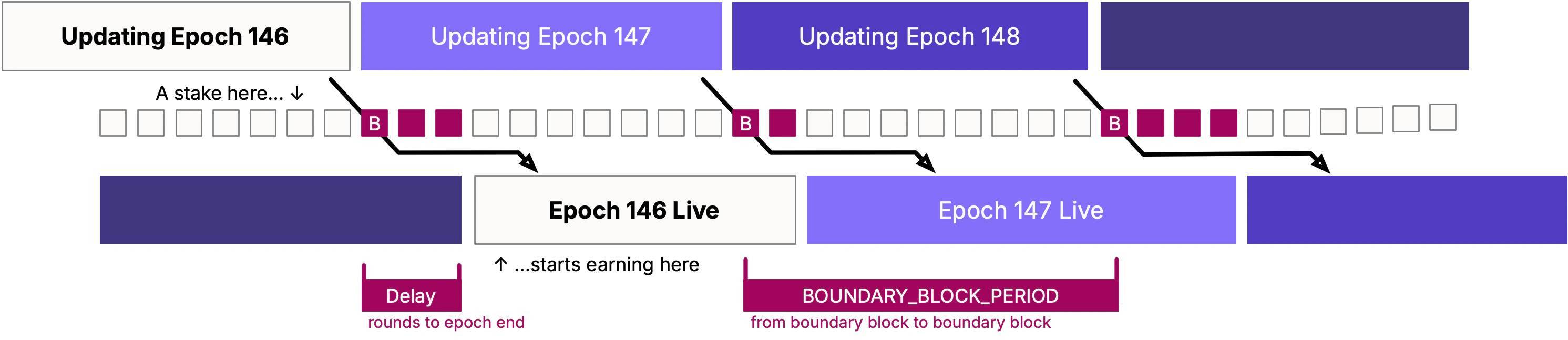
- Epoch n+1 — if submitted before the boundary block
- Epoch n+2 — if submitted after the boundary block (in the epoch delay period)
getEpoch() to check the current epoch and whether the boundary has passed:
A round is not a block — rounds increment even on missed proposals. You cannot calculate epoch boundaries with modular arithmetic on block numbers. Always use
getEpoch().Withdrawal delay
Undelegated stake is not immediately available. After callingundelegate, you must wait WITHDRAWAL_DELAY (1 epoch) before calling withdraw to reclaim the funds.
Common actions
Delegate
To delegate MON to a validator, calldelegate(validatorId) with the amount as msg.value:
msg.valuemust be at leastDUST_THRESHOLD(1 gwei).- Your delegation becomes active in the next epoch (or the one after, if past the boundary block).
- If this causes the validator’s total stake to meet
ACTIVE_VALIDATOR_STAKE, the validator is added to the active set.
Undelegate and withdraw
Removing stake is a two-step process: Step 1: Undelegate — Initiate the withdrawal by specifying the amount and awithdrawId (0–255):
WITHDRAWAL_DELAY epochs have passed, call withdraw to reclaim the funds:
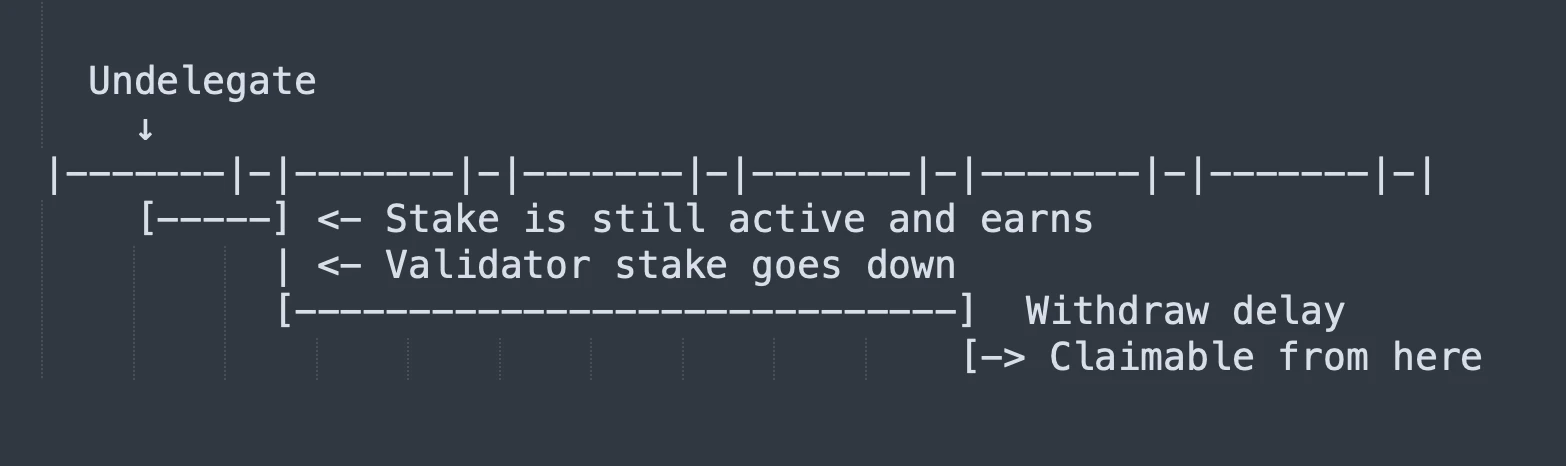
Timeline of withdrawability of stake relative to undelegate
- You can only undelegate active stake (not pending delegations).
- Each
(validator, delegator)pair supports up to 256 concurrent withdrawal requests. withdrawIds can be reused after the withdrawal completes.
Claim and compound rewards
Rewards accumulate automatically as your validator produces blocks. You have two options:-
Claim rewards — withdraw accumulated rewards to your account:
Claims take effect immediately — no epoch delay.
-
Compound rewards — re-delegate accumulated rewards, increasing your stake:
Compounded rewards activate in the next epoch (following the standard timing rules).
Query staking state
Key view methods for reading staking state:
Paginated methods return up to 100 results per call. Pass
startIndex = 0 for the first call, then use nextIndex for subsequent calls until isDone is true.
Constraints
Because the staking system is a precompile rather than a smart contract, it has some behavioral differences.- Only
CALLis allowed.STATICCALL,DELEGATECALL, andCALLCODEwill revert. This means all view methods usenonpayablestate mutability rather thanview. - No forked environment testing. The staking system is a precompile, not a smart contract — there is no code at the address, so forked testing environments won’t work.
- Boundary block timing. Actions submitted during the epoch delay period (after the boundary block) won’t take effect until two epochs later. Check
getEpoch()if timing matters. - Dust threshold. Delegations below
DUST_THRESHOLD(1 gwei) will revert. - EIP-7702 caveat. If an account delegates to the staking precompile address using EIP-7702, all calls to it will revert.
Further reading
- API reference — Full reference for the staking precompile with method signatures, parameters, gas costs, events, structs, and ABI
- How staking works — How Monad’s staking system determines validator voting weights, epoch scheduling, and reward distribution